 Daylytix
Growing an SEO agency by adding one hire for every few new clients is hard to make work at agency margins - every new hire adds overhead, management complexity, and delivery risk. The alternative is to remove the manual, repeatable parts of SEO delivery so that each analyst can look after more clients without a matching rise in hours.
This is not a new idea, but the tools available to do it keep improving. If you haven’t looked at your delivery stack for a while, it is worth checking what still takes hours that a tool could take over.
Where Agency Time Actually Goes
Before automating anything, find out where your team’s hours actually go. Track time for two weeks in four buckets:
- Auditing and reporting - running initial audits, building monthly reports, checking crawl results, compiling data from multiple tools into a deliverable.
- Client communication - reporting calls, follow-up emails, explaining what the data means, fielding questions that arise from confusing reports.
- Keyword research and content briefs - pulling data, building templates, writing briefs for content teams.
- Actual strategy - diagnosis, competitive analysis, making judgment calls, building the roadmap that differentiates your work.
Clients pay mostly for the last bucket, yet it is often the smallest. The usual first target for automation is auditing and reporting, because it is repetitive and data-driven, and it recurs every month for every client.
The Automation Stack
The activities that can be reliably automated without quality loss:
- Technical audits: Scheduled crawls (weekly or monthly is enough for most sites) with automated issue detection. No analyst involvement until a critical issue requires investigation.
- Rank tracking: Automated position monitoring that flags keywords that dropped, so analysts look at the movers instead of checking every keyword by hand.
- Client reports: Auto-generated PDF or slide deck reports with scheduled email delivery. The analyst checks the first reports carefully; after that, the review is a quick look for anything unusual before the client reads it.
- Monitoring alerts: Score drops, new critical issues such as broken pages, and performance regressions are flagged automatically. Analysts are pulled in only when the alert requires a response.
- Data aggregation: Pulling GSC, GA4, and crawl data into a single view is pure automation. No analyst should be copying data between tools.
What Cannot Be Automated
The risk in over-automating is commoditisation. If you automate everything, what are clients paying for? The answer should be clear judgment - the things that require expertise, relationships, and context that tools cannot replicate:
- Client relationships: Understanding the client’s business, their priorities, their risk tolerance. This requires a human.
- Strategy: Deciding which 3 of 47 detected issues to prioritise, given the client’s goals and budget. That’s judgment.
- Creative content direction: Identifying the content angle that will resonate with a specific audience is not something any tool can do reliably.
- Link prospecting and outreach: Relationship-based link building is still fundamentally human work.
The pitch to clients shouldn’t be “we use software to do your SEO.” It should be “our automation handles the monitoring and reporting so our strategists spend their client time on what actually moves rankings.”
Standardising Deliverables
Custom deliverables for every client are a scaling trap. The time spent reformatting reports, redesigning proposals, and building one-off dashboards is time not spent on strategy. The solution is a fixed, high-quality template structure:
- One report template that all clients receive, with consistent structure and visual design.
- One audit output format that is immediately readable by any analyst on your team - not dependent on the person who ran the audit knowing which tab has the important data.
- One proposal format with a fixed structure, customised only in the specific recommendations and pricing section.
Customisation should happen in the narrative - the specific insights, the strategic rationale for this client - not in the format. Every hour spent reformatting a template is an hour of wasted margin.
Tip: Start with one workflow, not all of them. Scheduled audits with the report emailed automatically are usually the easiest win: set them up for a few clients, compare the hours against your two-week time log, and only then roll them out to everyone.
Client Capacity Per Analyst
There is no standard number of clients per analyst - it depends on the size of the accounts, the services you sell and how much is automated. What you can do is measure it: count the hours each client takes per month before and after automating, and see how many more accounts the same analyst can carry.
Then do the maths with your own numbers: clients per analyst times your average retainer is the monthly revenue one analyst supports. If automation frees enough hours for even two more accounts per analyst, the extra revenue comes at almost no extra salary cost. That is the business case.
The caveat is that this assumes the analyst is genuinely good at the strategy work. Automation amplifies the skill of a strong analyst. It doesn’t substitute for someone who knows what they’re doing - it just removes the repetitive work so they can do more of the high-value work.
How Daylytix Fits In
Daylytix is built for this workflow. It covers scheduled audits (daily, weekly or monthly) that can email the PDF report to the client through your own SMTP settings, PowerPoint export on the Pro and Agency plans, rank tracking from Search Console data that flags keywords that dropped, alerts when the score drops, new critical issues appear or a performance budget is crossed, and a Search Console portfolio view that shows clicks, impressions, CTR and position for every connected site on one screen. White-label branding and the client portal are part of the Agency plan.
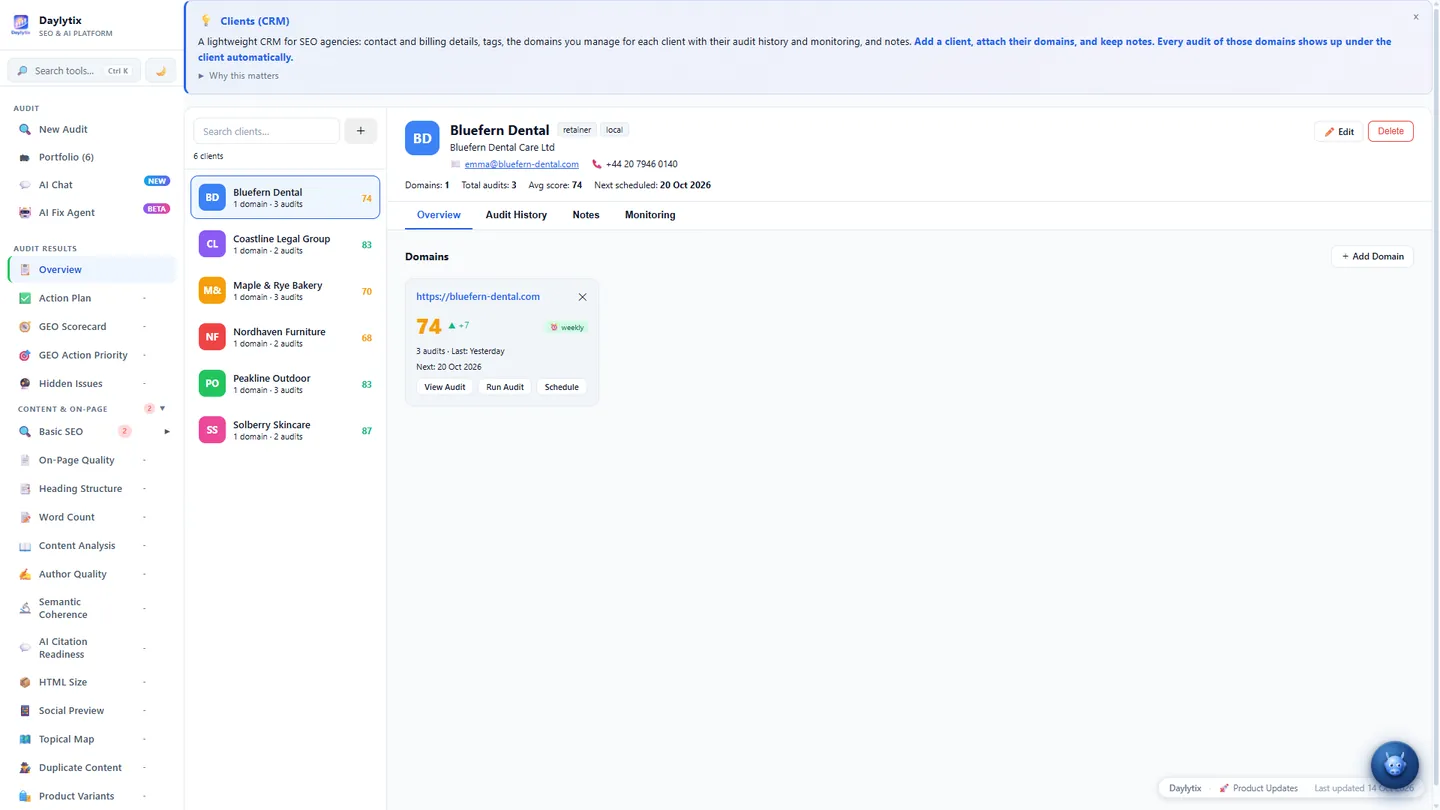
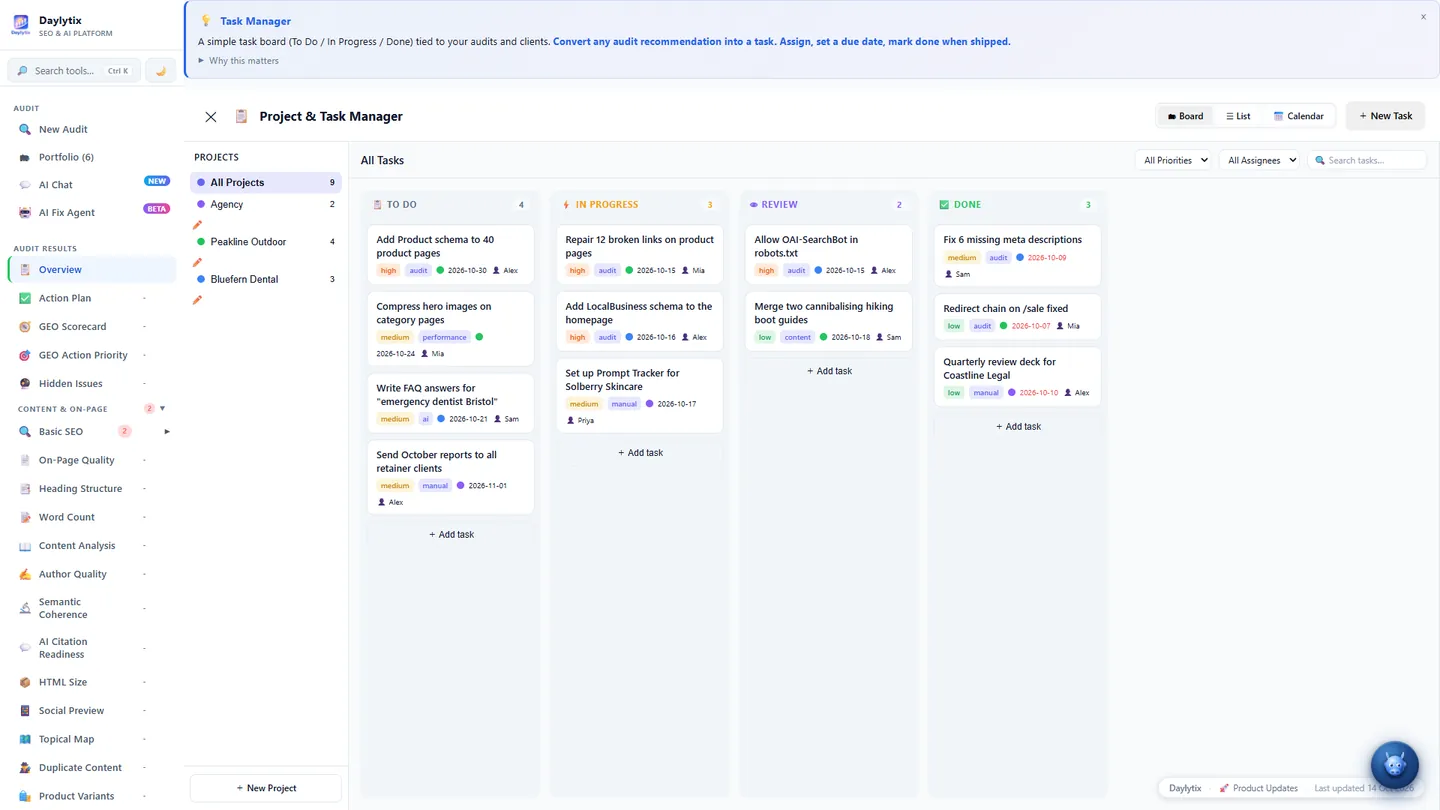
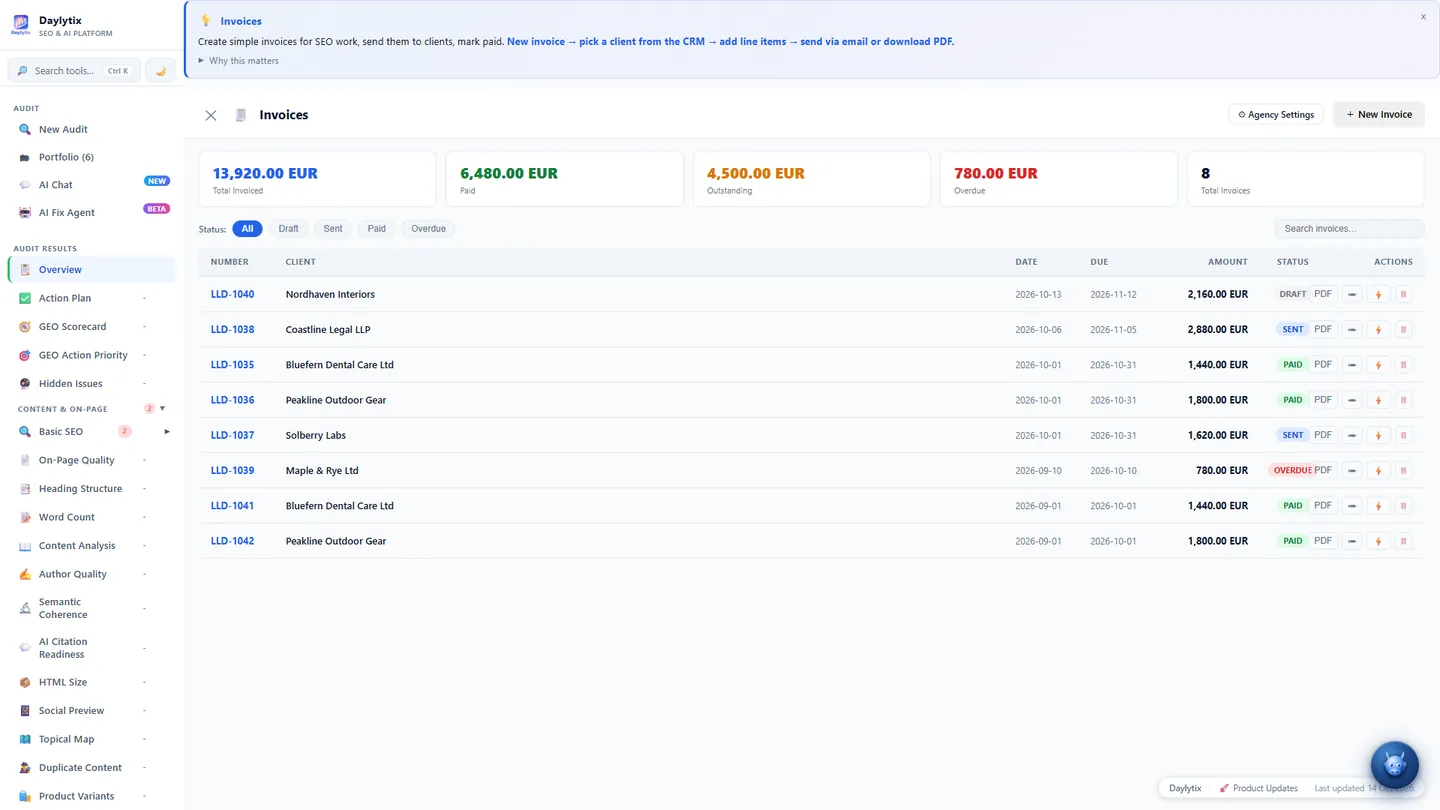
The agency side sits in the same place. On the Agency plan, Clients (CRM) keeps each client’s domains, audits and next scheduled audit together, and Invoices shows what each client has paid. The task board, on every plan, turns audit recommendations into tasks with an owner and a due date.
The goal is to take over as much of the delivery routine as possible, so your team spends client time on diagnosis, strategy, and relationships - the work that justifies the retainer and differentiates your agency from the next one using the same toolset.