An SEO audit tool crawls your site the way a search engine does and tells you what stops your pages from ranking: broken links, redirect chains, missing tags, slow pages, blocked resources. In 2026 the good ones also tell you whether AI search engines can reach and quote your content. We compared ten of them on crawl limits, technical depth, AI search checks, client reporting and real prices.
- Deep technical crawls of large sites: Screaming Frog SEO Spider, €245 a year, free up to 500 URLs.
- Visual audits that explain every issue: Sitebulb, from $18 a month.
- Agencies that want audits, AI search checks and client reports in one place: Daylytix, from €9.99 a month.
- You already pay for an SEO suite: the Site Audit in Semrush or Ahrefs.
- No budget at all: Google Search Console plus the free Ahrefs Webmaster Tools.
Disclosure: Daylytix is our product. We include it where it fits, and we say plainly where it does not: if you audit sites with tens of thousands of pages, another tool on this list will serve you better.
How we compared these tools
Six things decide whether an audit tool earns its place in your workflow:
- Crawl limit. How many pages it will crawl per audit or per month. This rules tools in or out faster than anything else.
- Technical depth. JavaScript rendering, Core Web Vitals, redirects, canonicals, hreflang and structured data.
- AI search checks. Whether AI crawlers can reach your pages, whether you publish an llms.txt file, and how quotable your content is. This is the newest area and the one where tools differ most.
- Client reporting. PDF exports, branding and white-label reports, if you work for clients.
- Integrations. Google Search Console and GA4, so issues sit next to real clicks and traffic.
- Price and trial. What you actually pay, and whether you can try it first.
Every price, limit and feature below comes from the vendor’s own pricing or product page, checked on 3 October 2026, and each section links to its source. Prices change, so confirm on that page before you buy. We did not buy plans for the other tools to write this article, so we describe what each vendor documents rather than claim benchmarks we did not run.
The 10 best SEO audit tools at a glance
| Tool | Best for | Crawl limit | AI search | White-label | Price |
|---|---|---|---|---|---|
| Screaming Frog | Deep technical crawls | 500 URLs free, unlimited paid | AI prompts while crawling | No | €245/year Free up to 500 URLs |
| Daylytix | Agencies and freelancers | 500 to 5,000 pages per audit | Yes, GEO readiness scorecard | Agency plan | €9.99/month 7-day trial, no card Start free trial → |
| Sitebulb | Visual audits | 10,000 (Lite) or 500,000 (Pro) URLs per audit | MCP access to Claude and ChatGPT | Customised PDFs (Pro) | $18/month 14-day trial |
| Semrush | Teams already on Semrush | Not published per plan | Yes, AI Search Health | Add-on, €19.18/month | €134/month 7-day trial |
| Ahrefs | Teams already on Ahrefs | 100,000 crawl credits (Lite) | Separate product (Brand Radar) | No | $29/month Free for verified sites |
| SE Ranking | High crawl volume for the price | 250,000 pages/month (Core) | Separate AI trackers | Add-on, €59/month | €109/month 14-day trial, no card |
| SEOptimer | Quick client-facing audits | 4 to 50 crawls/month | Yes, AI search visibility | From the $39 plan | $29/month 14-day trial |
| Seobility | Small budgets | 100 pages free, 25,000 Premium | Yes, AI bot access | Premium and up | €59.90/month Free plan |
| Google Search Console | Everyone, as a baseline | Your verified site | No separate report | No | Free |
| Lumar | Enterprise sites | Custom | Yes, GEO/AEO platform | Custom | Custom Demo only |
Prices as shown on each vendor’s pricing page on 3 October 2026, in the vendor’s currency. “AI search” records what each vendor advertises for its audit tool.
1. Screaming Frog SEO Spider
Screaming Frog is the desktop crawler most technical SEOs learned on, and it is still the reference for raw crawl depth. You install it, point it at a site and get every URL with its status code, titles, meta data, headings, canonicals, directives and links, ready to filter and export.
What stands out
- Unlimited crawling on the paid licence. The free version already includes JavaScript rendering, scheduling and the Search Console and Google Analytics integrations, capped at 500 URLs.
- Core Web Vitals data through the PageSpeed Insights integration.
- AI features for analysts: custom prompts with OpenAI, Gemini, Ollama and Anthropic while crawling, and detection of semantically similar pages with vector embeddings.
- Volume pricing for teams: €235 per licence from 5 licences, down to €209 from 20.
Limits
- It is a crawler, not a reporting tool. Turning a crawl into something a client reads takes extra work in spreadsheets or a dashboard.
- It runs on your machine, so very large crawls depend on that machine’s memory and need to be configured with care.
Source: Screaming Frog pricing and SEO Spider features, checked 3 October 2026.
2. Daylytix
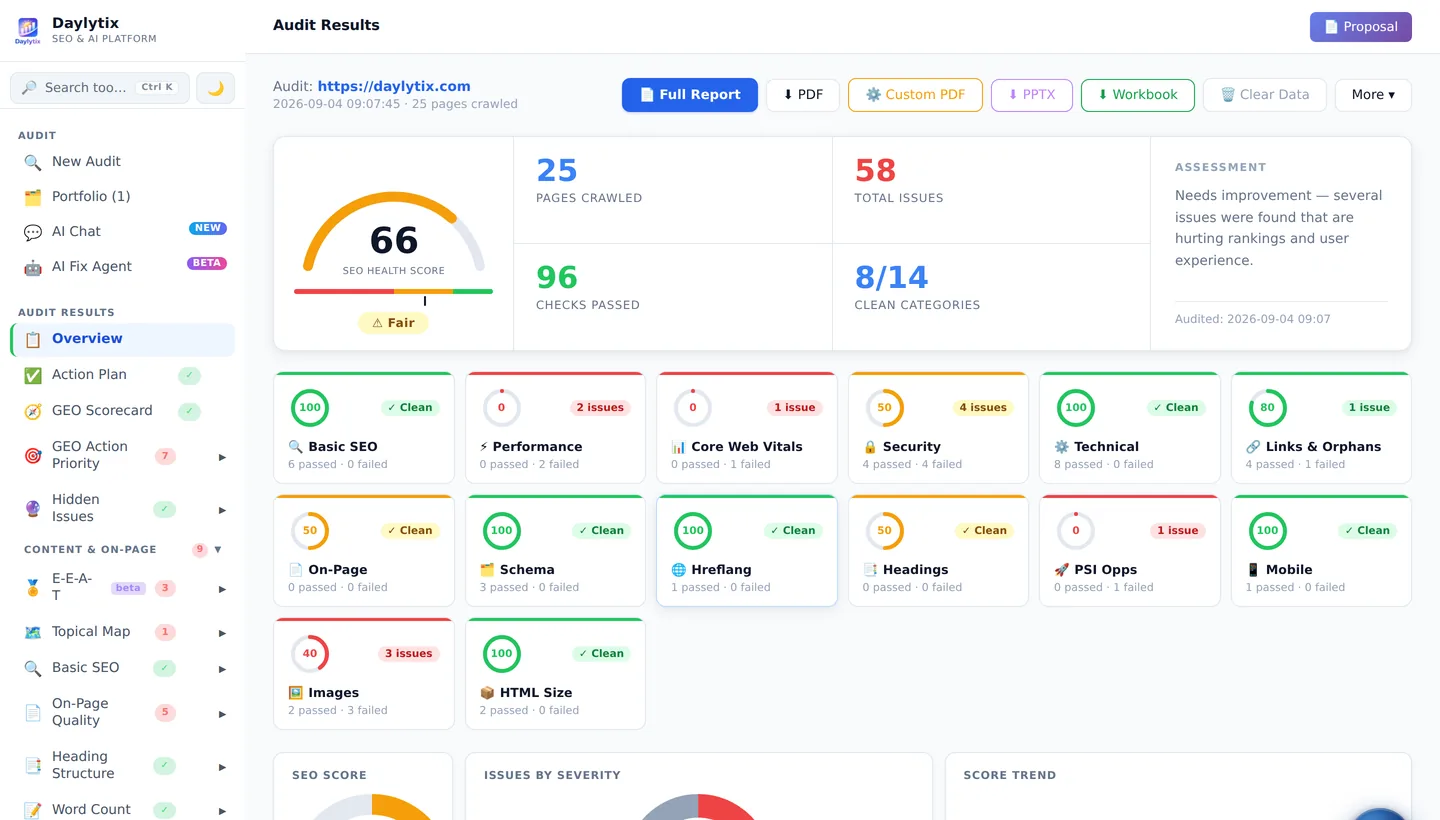
Daylytix is a cloud audit platform built for people who have to explain an audit to someone else. It runs more than 150 automated checks across 67 report sections, scores the site, and turns the findings into an action plan and a report you can send.
What stands out
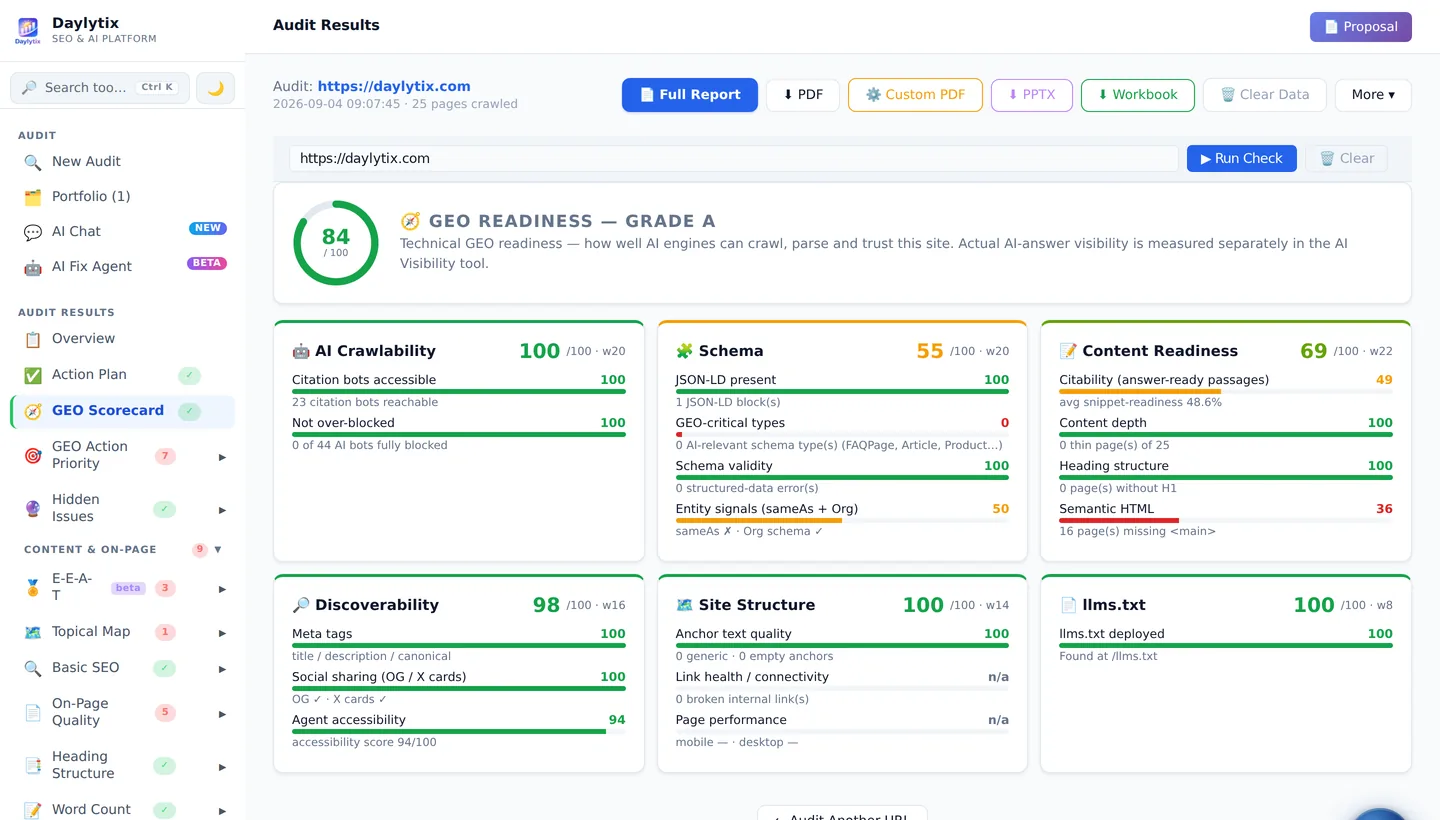
- AI search readiness built into every audit. A GEO scorecard checks whether AI citation bots can crawl the site, whether structured data and entity signals are in place, how quotable the content is, and whether an llms.txt file is published.
- Search Console and GA4 on every plan, so issues sit next to real clicks, impressions and sessions.
- Client reporting: branded PDF reports on every plan, PPTX slide decks from Pro, and white-label branding with a client portal on Agency.
- Deeper analysis from Pro: JavaScript rendering audit, content decay detection and a topical authority map.
- Scheduled monitoring with alerts, a rank tracker and score history on every plan.
Limits
- Page limits per audit: 500 on Starter, 2,000 on Pro and 5,000 on Agency. That covers most small business, SaaS and agency client sites, but not a large e-commerce catalogue or a news site. For those, use Screaming Frog, Sitebulb or Lumar.
- No backlink index of its own: backlink data comes from your own DataForSEO, Ahrefs or Moz account, connected in settings.
- A younger product than most tools on this list.
Source: Daylytix pricing, 3 October 2026. Plans: Starter (1 domain, 500 pages per audit), Pro (5 domains, 2,000), Agency (unlimited domains, 5,000).
3. Sitebulb
Sitebulb is a desktop crawler with a strong emphasis on explanation. Instead of a raw table it groups problems into prioritised “Hints” and explains why each one matters, which makes it popular with consultants who want depth without spreadsheet work.
What stands out
- Lite crawls 10,000 URLs per audit with 100+ Hints; Pro crawls 500,000 URLs with 300+ Hints, audit comparisons, scheduled audits and customised PDF reports.
- JavaScript crawling at no extra cost, plus Google Analytics, Search Console and Sheets integrations.
- MCP access, which lets you bring crawl data into Claude or ChatGPT.
- A cloud version for teams that crawl without project limits.
Limits
- Sitebulb does not advertise checks specific to AI search, such as AI crawler access or llms.txt.
- Extra users on Pro are paid per seat, from £7 a month.
Source: Sitebulb pricing, checked 3 October 2026 (monthly billing, USD).
4. Semrush Site Audit
Site Audit is one part of the Semrush suite, alongside keyword research, backlink analysis and rank tracking. If your team already lives in Semrush, its audit is the path of least resistance.
What stands out
- “AI Search Health” monitoring, which Semrush describes as spotting issues that can reduce your visibility in LLMs and AI-driven results.
- Everything else in the suite: keyword, competitor and backlink data next to the audit.
- A free SEO checker on its Site Audit page for a quick look at a single site.
Limits
- The highest entry price among the tools here with public prices, if the audit is all you need.
- Branding and white-label reports are a paid add-on (Pro Report, €19.18 a month).
- Crawl limits per plan are not shown on the pricing page.
Source: Semrush pricing and Site Audit, checked 3 October 2026.
5. Ahrefs Site Audit
Ahrefs is best known for its backlink index, and its Site Audit checks for more than 170 technical and on-page issues, with JavaScript rendering. Its most useful offer for many readers is the free one.
What stands out
- Ahrefs Webmaster Tools is free on an unlimited number of verified sites, with Site Audit at 5,000 crawl credits per project per month.
- Paid plans scale crawl credits and projects: Lite 100,000 credits and 5 projects, Standard ($249) 500,000 and 20, Advanced ($449) 1,500,000 and 50.
- Backlink and keyword data in the same tool, if you also need them.
Limits
- AI search visibility is a separate product, Brand Radar, from $199 a month, rather than part of Site Audit.
- No white-label reporting.
Source: Ahrefs pricing, Site Audit and Webmaster Tools, checked 3 October 2026.
6. SE Ranking
SE Ranking is an all-in-one platform that has long competed on value. Its Website Audit runs 115+ checks covering crawlability, redirects, sitemaps, meta tags, content, speed, JavaScript, links and mobile.
What stands out
- Generous crawl volume: 250,000 pages a month on Core (10 projects), 2 million on Growth (€235 a month, 30 projects).
- A 14-day trial with no card required.
- Separate trackers for AI Overviews, AI Mode, ChatGPT, Gemini and Perplexity.
Limits
- White-label reporting is the Agency Pack add-on, €59 a month, billed yearly only.
- The Website Audit itself does not advertise AI crawler or llms.txt checks.
Source: SE Ranking pricing and Website Audit, checked 3 October 2026.
7. SEOptimer
SEOptimer is built around fast, presentable audits. Agencies use it to send a branded report to a prospect, or to embed an audit form on their own site that collects leads.
What stands out
- White-label PDF reports from the $39 White Label plan (10 crawls, 3 users).
- An embeddable audit tool for lead generation on the $59 plan (50 crawls, 6 users).
- It advertises AI search checks: how a site shows up in AI search and LLMs, including LLM accessibility and citability.
- 25% off with yearly billing.
Limits
- Crawl allowances are small (4 crawls on the $29 plan), and pages per crawl are not published.
Source: SEOptimer pricing, checked 3 October 2026.
8. Seobility
Seobility checks 300+ factors per page across technical issues, on-page factors and content quality, and it is one of the few tools with a free plan you can keep using.
What stands out
- A free plan: one project, 100 pages per crawl.
- An AI bot access check that shows which pages OAI-SearchBot, PerplexityBot or Claude-SearchBot can reach and which robots.txt blocks.
- White-label reports from Premium (3 projects, 25,000 pages per crawl); Professional (€99.90) and Agency (€209.90) raise the limits to 50,000 and 100,000 pages.
Limits
- The free plan is enough for a small site only.
- Premium starts at €59.90 a month, above the entry plans of several tools on this list.
Source: Seobility pricing and Website Audit, checked 3 October 2026.
9. Google Search Console
Search Console is not a crawler, but no audit is complete without it, because it is the only source of what Google itself sees. Crawlers simulate what a search engine sees; Search Console shows what Google actually did.
What stands out
- The Page indexing report: which pages Google indexed, and why the others were left out.
- Core Web Vitals from real users, not lab tests.
- Clicks, impressions and positions by query and page, and URL Inspection for a single page.
Limits
- It covers only sites you have verified, and it does not crawl your whole site on demand.
- No prioritised fix list and no client reporting.
10. Lumar
Lumar (formerly Deepcrawl) is a cloud platform for large and mid-market organisations that need SEO, accessibility and site health monitored across big sites and many teams. It positions itself as a website optimization, SEO and GEO/AEO (AI search) platform.
Limits
- No public prices and no self-service trial: you fill in a form or request a demo.
- More than a small team or a single consultant needs.
Source: Lumar pricing, checked 3 October 2026.
Which SEO audit tool should you choose?
Start with the size of the sites you audit and who reads the result.
Freelancers and small agencies
You audit client sites of a few hundred to a few thousand pages and have to explain the findings. A tool that produces a prioritised plan and a report you can send saves more time than raw crawl depth. Daylytix (from €9.99) and SEOptimer (from $29) are built for this; Seobility’s free plan covers a very small site.
Growing agencies
Branding and multiple clients matter. Look at what white-label costs, not the headline price: it is included in Daylytix Agency (€59.99) and Seobility Premium (€59.90), and an add-on at Semrush (€19.18 a month on top) and SE Ranking (€59 a month, billed yearly).
In-house teams on large sites
Crawl limits decide it. Screaming Frog (unlimited on the paid licence) and Sitebulb Pro (500,000 URLs per audit) handle large sites; SE Ranking crawls 250,000 pages a month on Core.
Enterprise
Lumar, or Sitebulb Cloud, if you need monitoring across many teams and sites.
No budget
Google Search Console plus Ahrefs Webmaster Tools gives you indexing data from Google and a 5,000-credit site audit for each verified site, at no cost.
What a good SEO audit should check in 2026
Whatever tool you pick, make sure it covers these, or that you cover them some other way:
- Indexability: status codes, noindex tags, canonicals, robots.txt and the XML sitemap. Pages that cannot be indexed cannot rank.
- Redirects and links: chains, loops, broken internal links and orphan pages with no links pointing to them.
- On-page basics: titles, meta descriptions, headings, thin and duplicate content. See how long a title tag should be.
- JavaScript rendering: content that only appears after scripts run can be missed. See JavaScript SEO.
- Core Web Vitals: LCP, INP and CLS from real users where possible. See Core Web Vitals in 2026.
- Structured data: valid JSON-LD for the page type. See how to add schema markup.
- AI search readiness: whether AI crawlers are allowed in robots.txt, whether you publish an llms.txt file, and whether your pages answer questions in quotable passages. See what llms.txt is and how to rank in AI Overviews.
For the full list, use our technical SEO audit checklist.
Frequently asked questions
Which tool is best for an SEO audit?
It depends on site size and who reads the result. Screaming Frog is the reference for deep technical crawls of large sites, Sitebulb adds clear explanations, and Daylytix suits agencies that need audits, AI search checks and client reports for sites of up to a few thousand pages.
What is the best free SEO audit tool?
Google Search Console, because it shows what Google itself sees. Pair it with Ahrefs Webmaster Tools, which is free for verified sites and includes a site audit, or with the free version of Screaming Frog, which crawls up to 500 URLs.
Can ChatGPT do an SEO audit?
Not on its own. A chatbot cannot crawl your whole site, read your server responses or see your Search Console data, so it cannot find broken links, redirect chains or indexing problems. It is useful for explaining findings or drafting fixes once a crawler has found the issues.
Can I do my own SEO audit?
Yes. Connect Google Search Console, run a crawl with an audit tool, and work through indexability, links, on-page basics, speed, structured data and AI search readiness in that order. Fix what blocks indexing first, then what affects the most traffic.
What is the best SEO audit tool for agencies?
One that turns an audit into a report a client can read, with your branding. Compare what white-label really costs: it is included in Daylytix Agency and Seobility Premium, and a paid add-on at Semrush and SE Ranking. You can try Daylytix free for 7 days on a client site.
How often should you run an SEO audit?
Run a full audit when you take on a site and after any redesign or migration, then let scheduled monitoring catch new problems between audits. For most sites a monthly check is enough; sites that publish or change daily benefit from weekly monitoring.